
The present case involves a contention regarding a dishonored cheque for ₹2,00,000, issued by the appellant, Prem Raj, to the complainant, Poonamma Menon, on 30th June 2002, which was invalidated ...
No Acts & Articles mentioned in this case
2024 INSC 260 REPORTABLE
IN THE SUPREME COURT OF INDIA
CRIMINAL APPELLATE JURISDICTION
CRIMINAL APPEAL NO………………OF 2024
(Arising out of Special Leave Petition (Crl.) No.9778/2018)
PREM RAJ … APPELLANT(S)
VERSUS
POONAMMA MENON & ANR. …RESPONDENT(S)
J U D G M E N T
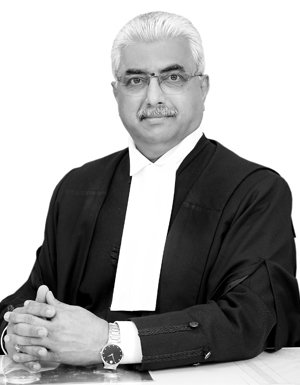
SANJAY KAROL, J.
Leave granted.
2.Appellant herein challenges judgment and order dated 23
rd
January, 2018
passed in Crl.R.P. No.1111 of 2011
1
, whereby the High Court of Kerala allowed,
only in part, his Revision Petition against the judgment and order of the learned
Additional Sessions Judge, Thrissur,
2
dated 11
th
January, 2011, in Criminal
Appeal No.673 of 2007, which, in turn, upheld his conviction, as handed down
by the learned Judicial First Class Magistrate
3
vide order dated 14
th
August,
1 ‘Impugned Judgment’
2 ‘Lower Appellate Court’
3 ‘Trial Court’
1| SLP (Crl) 9778 of 2018
2007 in CC No.51 of 2003, under Section 138 of the Negotiable Instruments
Act, 1881.
4
3. The sole issue that we are required to consider is, whether, a criminal
proceeding can be initiated and the accused therein held guilty with natural
consequences thereof to follow, in connection with a transaction, in respect of
which a decree by a competent Court of civil jurisdiction, already stands passed.
4. The facts necessary to put into perspective the issue in the present appeal
are:-
4.1 The Appellant borrowed Rs.2,00,000/- from the Complainant,
K.P.B Menon “Sreyes," with the promise that he would repay it on
demand.
4.2 On receipt of such demand, he issued a cheque dated 30
th
June,
2002 for the said amount from the South Indian Bank, encashment
thereof was to be through Canara Bank, Irinjalakuda Branch, to which
the cheque was sent through the post with a covering letter dated 24
th
September, 2002.
4.3 It was dishonoured due to insufficient funds and ‘payments stopped
by drawer’. The Complainant came to know of such dishonour and
issued a notice of demand dated 22
nd
December, 2002. Accounting for
no action on the part of the appellant, the complaint, the subject matter
of the instant proceedings, came to be filed.
4 ‘N.I. Act’
2| SLP (Crl) 9778 of 2018
5. Equally, though, the appellant (accused) had filed Original Suit No.1338
of 2002. The five parties impleaded as defendants were, (i) K.P. Bhaskara
Menon; (ii) K.P. Vipinendra Kumar
5
; (iii) Praveen Menon; (iv) The Manager
South Indian Bank Limited Kathikudam, Via Koratty, Trichur; and (v) N.T.
Raghunandanan. The prayers made therein were to, (a) declare cheque
No.386543 of the South Indian Bank Limited, Kathikudam, as a security
cheque; (b) issue mandatory injunction directing the 1
st
defendant to return the
said cheque; and (c) issue a permanent prohibitory injunction restraining
defendants 1 to 4 named hereinabove from taking any steps to encash the said
cheque.
5.1The Additional District Munsif, Irinjalakuda, decreed the Suit on
11
th
April, 2003 in favour of the plaintiff (accused). The Suit in respect of
defendant No.4, namely the Manager, South Indian Bank, was dismissed
and the Suit was wholly decreed against the remaining defendants.
5.2Defendant No.1 filed an appeal before the Additional Subordinate
Judge, Irinjalakuda in C.M.A.No.6/2006. In its judgment dated 30
th
January, 2007, the Court observed that “The lower court correctly
analysed the facts and arrived at the right conclusion. I find no reason to
interfere the order of the lower court. Hence I dismissed this appeal.”
5 2
nd
defendant
3| SLP (Crl) 9778 of 2018
6.Therefore, it appears from the record that the very same cheque was in
issue before the Civil Court and also the Court seized of the Section 138 N.I.
Act complaint.
The conclusions drawn by the Courts below, subject matter of the instant lis, are
as under:
6.1The Trial Court convicted the appellant herein to undergo simple
imprisonment for one year as well as pay compensation of Rs.2 lakhs in
default whereof, he was to undergo further simple imprisonment for six
months. The determination of the issues, i.e., whether the decree passed by
the Munsif Court would be binding on it, is of note. It was observed that a
Court exercising jurisdiction on the criminal side is not subordinate to the
Civil Court. Further, it was held “That order was an ex-parte order as far
as criminal complaint is concerned the order of injunction issued cannot be
granted and the hands of the criminal court cannot be fettered by the civil
court”.
6.2 The First Appellate Court framed primarily one point for
consideration – whether the cheque was issued against a legally
enforceable debt, thereby attracting the offence under Section 138 of the
N.I. Act. This point was held against the appellant and therefore, the
conviction handed down by the Court below, accordingly confirmed.
4| SLP (Crl) 9778 of 2018
7.The High Court, in revision, observed that no perversity could be
indicated in the concurrent findings of the Trial Court and First Appellate Court.
The same was dismissed.
8.We find the manner in which this matter has travelled up to this Court to
be quite concerning. We fail to understand as to how a civil as well as criminal
course could be adopted by the parties involved, in respect of the very same
issue and transaction, in these peculiar facts and circumstances.
9.In advancing his submissions, Mr. K. Parameshwar, learned counsel
appearing for the appellant, placed reliance on certain authorities of this Court.
In M/s. Karam Chand Ganga Prasad & Anr. vs. Union of India & Ors.
6
, this
Court observed that:
“…….It is a well-established principle of law that the
decisions of the civil courts are binding on the criminal
courts. The converse is not true.”
In K.G. Premshanker vs. Inspector of Police & Anr
7
., a Bench of three
learned Judges observed that, following the M.S. Sheriff vs. State of Madras
8
,
no straight-jacket formula could be laid down and conflicting decisions of civil
and criminal Courts would not be a relevant consideration except for the limited
purpose of sentence or damages.
6 (1970) 3 SCC 694
7 (2002) 8 SCC 87
8 AIR 1954 SC 397
5| SLP (Crl) 9778 of 2018
10.We notice that this Court in Vishnu Dutt Sharma vs. Daya Sapra (Smt.)
9
,
had observed as under:
“26. It is, however, significant to notice a decision of this
Court in Karam Chand Ganga Prasad v. Union of India
(1970) 3 SCC 694, wherein it was categorically held that the
decisions of the civil court will be binding on the criminal
courts but the converse is not true, was overruled therein…”
This Court in Satish Chander Ahuja vs. Sneha Ahuja
10
considered a numerous
precedents, including Premshanker (supra) and Vishnu Dutt Sharma (supra),
to opine that there is no embargo for a civil court to consider the evidence led in
the criminal proceedings.
The issue has been laid to rest by a Constitution Bench of this Court in Iqbal
Singh Marwah vs. Meenakshi Marwah
11
:
“32. Coming to the last contention that an effort should be made to
avoid conflict of findings between the civil and criminal courts, it is
necessary to point out that the standard of proof required in the two
proceedings are entirely different. Civil cases are decided on the basis
of preponderance of evidence, while in a criminal case, the entire
burden lies on the prosecution, and proof beyond reasonable doubt has
to be given. There is neither any statutory provision nor any legal
principle that the findings recorded in one proceeding may be treated as
final or binding in the other, as both the cases have to be decided on the
basis of the evidence adduced therein. While examining a similar
contention in an appeal against an order directing filing of a complaint
under Section 476 of the old Code, the following observations made by
a Constitution Bench in M.S. Sheriff v. State of Madras [1954 SCR
1144: AIR 1954 SC 397: 1954 Cri LJ 1019] give a complete answer to
the problem posed: (AIR p. 399, paras 15-16)
“15. As between the civil and the criminal proceedings, we are of
the opinion that the criminal matters should be given precedence.
There is some difference of opinion in the High Courts of India on
9 (2009) 13 SCC 729
10 (2021) 1 SCC 414
11 (2005) 4 SCC 370
6| SLP (Crl) 9778 of 2018
this point. No hard-and-fast rule can be laid down but we do not
consider that the possibility of conflicting decisions in the civil and
criminal courts is a relevant consideration. The law envisages such
an eventuality when it expressly refrains from making the decision
of one court binding on the other, or even relevant, except for
certain limited purposes, such as sentence or damages. The only
relevant consideration here is the likelihood of embarrassment.
16. Another factor which weighs with us is that a civil suit often
drags on for years and it is undesirable that a criminal prosecution
should wait till everybody concerned has forgotten all about the
crime. The public interests demand that criminal justice should be
swift and sure; that the guilty should be punished while the events
are still fresh in the public mind and that the innocent should be
absolved as early as is consistent with a fair and impartial trial.
Another reason is that it is undesirable to let things slide till
memories have grown too dim to trust.
This, however, is not a hard-and-fast rule. Special considerations
obtaining in any particular case might make some other course more
expedient and just. For example, the civil case or the other criminal
proceeding may be so near its end as to make it inexpedient to stay it in
order to give precedence to a prosecution ordered under Section 476.
But in this case we are of the view that the civil suits should be stayed
till the criminal proceedings have finished.”
(Emphasis Supplied)
11. The position as per Premshanker (supra) is that sentence and damages
would be excluded from the conflict of decisions in civil and criminal
jurisdictions of the Courts. Therefore, in the present case, considering that the
Court in criminal jurisdiction has imposed both sentence and damages, the ratio
of the above-referred decision dictates that the Court in criminal jurisdiction
would be bound by the civil Court having declared the cheque, the subject
matter of dispute, to be only for the purposes of security.
12.In that view of the matter, the criminal proceedings resulting from the
cheque being returned unrealised due to the closure of the account would be
7| SLP (Crl) 9778 of 2018
unsustainable in law and, therefore, are to be quashed and set aside. Resultantly,
the damages as imposed by the Courts below must be returned to the appellant
herein forthwith.
13.The appeal is allowed in the aforesaid terms. Hence, the judgment and
order passed by Additional Sessions Judge, Thrissur, in Criminal Appeal 673 of
2007, which upheld the conviction, as handed down by the learned Judicial First
Class Magistrate in CC No. 51 of 2003, which came to affirmed by the High
Court of Kerela in Crl.R.P.No.1111 of 2011 is quashed and set aside. Pending
application(s), if any, shall stand disposed of.
……………………….J.
(SANJAY KAROL)
……………………….J.
(ARAVIND KUMAR)
New Delhi
April 02, 2024
8| SLP (Crl) 9778 of 2018

Legal Notes
Add a Note....