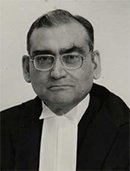
A luminary in the Indian judicial system, Justice Markandeya Katju's career is defined by his intellectual rigor, diverse interests, and significant contributions to jurisprudence.
Born on September 20, 1946, Justice Katju consistently achieved first division in every examination, from Senior Cambridge to LL.B. He topped the merit list in LL.B from Allahabad University in 1967, setting a high standard for his future legal endeavors.
Justice Katju practiced law at the Allahabad High Court, specializing in Labour Law, Taxation, and Writ Petitions. He served as Standing Counsel for the Income Tax Department, showcasing his expertise in tax-related matters. Additionally, he was a member of the International Association of Refugee Law Judges (IARIJ), attending conferences in Switzerland and various law-related conferences in Delhi and elsewhere. His elevation to the Bench in 1991 marked the beginning of his impactful judicial career, during which he delivered several landmark judgments.
Justice Katju has a keen interest in academics and a wide array of subjects, including Sanskrit, Urdu, History, Philosophy, Science, and Sociology, alongside his deep engagement with jurisprudence. He has authored several books, including ‘Law in the Scientific Era,’ ‘Interpretation of Taxing Statutes,’ and ‘Domestic Enquiry,’ reflecting his diverse intellectual pursuits. His judgments often reflect his unconventional and path-breaking approach, shaped by his study of diverse subjects.
Justice Katju comes from a distinguished family of legal luminaries. He is the son of the late Justice S.N. Katju, a former Judge of the Allahabad High Court, and the grandson of the late Dr. K.N. Katju, a former Union Home and Defence Minister, Governor of West Bengal and Orissa, and Chief Minister of Madhya Pradesh.
With a passionate love for Indian culture, Justice Katju is dedicated to uncovering and highlighting the intellectual achievements of India's ancestors. His efforts led to the publication of “Mimansa Rules of Interpretation,” in which he emphasized the significance of these rules, which he believes are largely unknown to even educated Indians today.
Justice Katju was appointed as the Chief Justice of the Madras High Court on November 28, 2004. His tenure at the Madras High Court was marked by significant judgments, including one on the constitutional relationship between the Judiciary and the Executive, and the doctrine of judicial restraint. He was later appointed as the Chief Justice of the Delhi High Court on October 12, 2005, and elevated to the Supreme Court on April 10, 2006.

 Login with google